Managed DevOps Services vs an In-House Team: How to Choose
A practical comparison of managed DevOps services and in-house teams, covering cost drivers, coverage, control and the hybrid model most growing companies end up with.

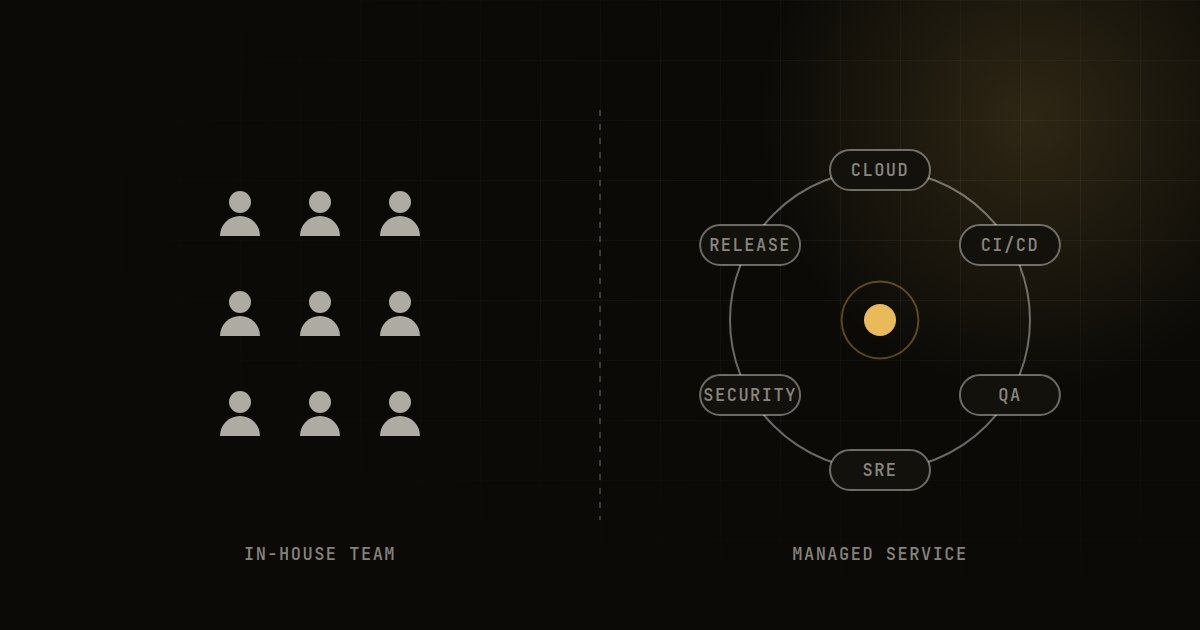
Managed DevOps services suit companies that need round-the-clock reliability, mature CI/CD and cloud governance faster than they can hire for it. An in-house team suits companies whose platform is a core differentiator and who can recruit and retain senior engineers. Most mid-size companies do best with a hybrid: internal ownership of architecture, with a partner running operations.
That is the short answer. The longer answer depends on your scale, your release cadence, how much of your infrastructure is genuinely unique and how painful your last on-call rotation was. This guide walks through the trade-offs the way we would with a CTO deciding between the two.
What managed DevOps services actually cover
The phrase gets used loosely, so it helps to be precise. A typical managed DevOps engagement covers some or all of the following:
- CI/CD pipelines: building, maintaining and improving build, test and deployment pipelines.
- Infrastructure as code: Terraform, Pulumi or CloudFormation modules, environment provisioning and drift control.
- Cloud operations: account structure, IAM hygiene, networking, backups, patching and cost governance.
- Observability and on-call: monitoring, alerting, incident response and post-incident reviews, often 24x7.
- Release management: change windows, rollbacks, feature flag hygiene and release coordination across teams.
- Security operations: vulnerability scanning, secrets management and compliance evidence collection.
An in-house DevOps or platform team does the same work, but you hire, manage and retain the people yourself. The question is less "who can do the work" and more "who should own which part of it".
The honest comparison
The table below summarises how the two models tend to compare. Your situation will shift some of these, so treat it as a starting point rather than a verdict.
| Factor | In-house team | Managed DevOps services |
|---|---|---|
| Time to capability | Months to hire and ramp a senior team | Weeks, since the team and runbooks already exist |
| 24x7 coverage | Needs enough engineers for a humane rotation, which small teams rarely have | Included in most service tiers |
| Context about your product | Deep, built over time | Shallower at first, improves with good documentation |
| Cost structure | Fixed salaries, hiring costs, attrition risk | Predictable monthly fee, scales with scope |
| Breadth of expertise | Limited to who you hire | Access to specialists (Kubernetes, FinOps, security) as needed |
| Key-person risk | High in small teams | Lower, since knowledge sits with a team |
| Control and speed of change | Direct, immediate | Governed by SLAs and a change process |
| Strategic platform work | Natural fit | Possible, but needs clear ownership on your side |
Where in-house clearly wins
If your infrastructure is your product, keep it in-house. A company selling a developer platform, a low-latency trading system or a specialised data product needs engineers who live inside that problem every day. Deep product context also matters when deployment logic is tightly coupled to business logic, for example in complex multi-tenant SaaS.
In-house teams also win on cultural integration. Platform engineers who sit with product teams shape how developers work, and that influence is hard to buy.
Where managed services clearly win
Managed DevOps services win when the work is essential but not differentiating. Patching, backup testing, alert tuning, certificate renewals and cloud account hygiene have to be done well, but they rarely set you apart from competitors.
They also win on coverage. A humane 24x7 on-call rotation needs enough people that nobody is paged every other week. For a company with two DevOps engineers, that is simply not possible without burning them out.
Cost drivers to model before you decide
Comparing a managed services quote against one engineer's salary is the most common mistake we see. The real comparison is total cost of capability.
For an in-house team, include:
- Salaries and benefits for the full rotation, not one hire. Senior DevOps and SRE talent in India and elsewhere is competitive, and pay reflects that.
- Hiring costs: recruiter fees, interview time from your senior engineers and the months a role sits open.
- Ramp-up time: new hires typically need a few months before they are fully effective on your stack.
- Attrition: when a key engineer leaves, undocumented knowledge often leaves with them.
- Tooling and training: monitoring licences, certifications and conference budgets.
- Management overhead: someone has to lead, review and grow the team.
For managed DevOps services, include:
- The monthly service fee, usually tied to scope, number of environments and coverage hours.
- Onboarding effort from your team in the first one to three months.
- Internal ownership: you still need at least one person who understands the architecture and holds the partner accountable.
- Change requests outside the agreed scope.
As a rough guide, managed engagements for mid-size companies range from a modest monthly retainer for business-hours support on a small estate to a substantial fee for full 24x7 coverage across multiple clouds and dozens of services. These ranges vary widely by scope, so insist on a quote tied to a written list of services and SLAs.
A decision checklist
Work through these questions with your leadership team. If most answers point one way, you have your direction.
- Is our infrastructure a competitive differentiator? If yes, lean in-house for architecture and platform design.
- Do we need 24x7 coverage today? If yes and your team is under five people, lean managed for on-call.
- How long would it take to hire three senior DevOps engineers? If the answer is more than two quarters, a partner bridges the gap.
- How much undocumented knowledge sits with one or two people? High key-person risk favours bringing in a team that documents by default.
- Are we preparing for an audit (SOC 2, ISO 27001, RBI or similar)? Managed providers often have evidence collection processes ready.
- Do our developers wait on infrastructure requests? If tickets pile up, you have a capacity problem that either model can solve, but not by doing nothing.
- Can we write down what "good" looks like? If you cannot define SLAs and outcomes, you are not ready to outsource, and you may not be ready to hire either.
The hybrid model most companies end up with
In practice, the choice is rarely binary. A common and effective pattern looks like this:
- In-house: a small platform or architecture function (often one to three people) that owns cloud strategy, reference architectures, developer experience and vendor accountability.
- Managed: a partner that runs day-to-day operations, on-call, patching, pipeline maintenance, cost reporting and compliance evidence.
This split keeps strategic decisions close to the product while removing the operational toil that burns out small teams.
A typical scenario: a Series B fintech with one strong DevOps lead and a growing list of production incidents. The lead is paged most nights, pipeline improvements stall and the upcoming audit looks daunting. Handing on-call, patching and evidence collection to a managed partner frees the lead to redesign the deployment pipeline and mentor product engineers on infrastructure as code. Six months later, the company hires a second platform engineer for strategic work, not firefighting.
How to evaluate a managed DevOps partner
If you decide to bring in managed DevOps services, evaluate providers on substance, not slide decks.
Ask about the people
Who will actually work on your account? Ask to meet the lead engineer, not just the account manager. Check their experience with your cloud provider, your orchestration layer and your compliance regime.
Ask about process
Request sample runbooks, a sample post-incident review and their escalation matrix. Good providers share these readily. Ask how they handle a change that goes wrong at 2 a.m. and who has authority to roll back.
Ask about exit
A partner confident in its work will make leaving easy. Ensure all infrastructure code lives in your repositories, all credentials sit in your secrets manager and documentation is yours. Avoid proprietary tooling that locks you in.
Ask about measurement
Agree on a small set of metrics from day one: deployment frequency, change failure rate, mean time to restore, alert noise and cloud cost trends. Review them monthly. Our CI/CD best practices guide covers these metrics in more detail.
Common mistakes to avoid
- Outsourcing ownership, not just work. Someone inside your company must understand the architecture and make decisions.
- Vague scope. "Manage our DevOps" is not a scope. List environments, services, SLAs and exclusions.
- Skipping the handover. Budget time for knowledge transfer from your current team, or the partner will learn by breaking things.
- Ignoring cost governance. Operations and cloud spend are linked. Pair operations with a FinOps discipline so savings do not leak.
Frequently asked questions
What are managed DevOps services?
Managed DevOps services are an arrangement where an external team runs some or all of your DevOps work, such as CI/CD pipelines, infrastructure as code, cloud operations, monitoring and on-call. You pay a recurring fee tied to scope and service levels. Your team keeps ownership of architecture and priorities.
Is managed DevOps cheaper than hiring in-house?
It often is for small and mid-size teams that need 24x7 coverage, because you avoid hiring a full on-call rotation. For large companies with steady, specialised platform needs, an in-house team can be more economical. Compare total cost of capability, including hiring, attrition and management time, not just one salary against one quote.
Can a startup use managed DevOps services?
Yes, and it is often a sensible choice before the company can justify a dedicated platform team. Keep infrastructure code in your own repositories and make sure at least one founder or engineer understands the setup. That keeps you in control as you grow.
How long does it take to onboard a managed DevOps provider?
For a mid-size estate, onboarding typically takes a few weeks to a couple of months. It covers access setup, documentation review, monitoring alignment and a shadowing period before the partner takes on-call responsibility. Poor existing documentation extends the timeline.
Will we lose control of our infrastructure?
Not if you structure the engagement well. Keep code, credentials and documentation in systems you own, define a clear change approval process and review agreed metrics monthly. Control comes from ownership and visibility, not from who types the commands.
How Sunday Labs can help
Sunday Labs runs managed services covering DevOps and CI/CD, cloud management, release management and 24x7 SRE support, usually alongside a small internal platform team. Every engagement is led by our founder, with senior engineers who have run production systems at scale, so you get people who have done this before rather than a rotating bench. If you are weighing managed DevOps against hiring, start a conversation and we will help you map the right split for your stage.