RAG vs Fine Tuning: How to Choose for Enterprise GenAI
RAG gives a model the right knowledge; fine-tuning changes how it behaves. A clear comparison and decision guide for choosing between them, or using both.

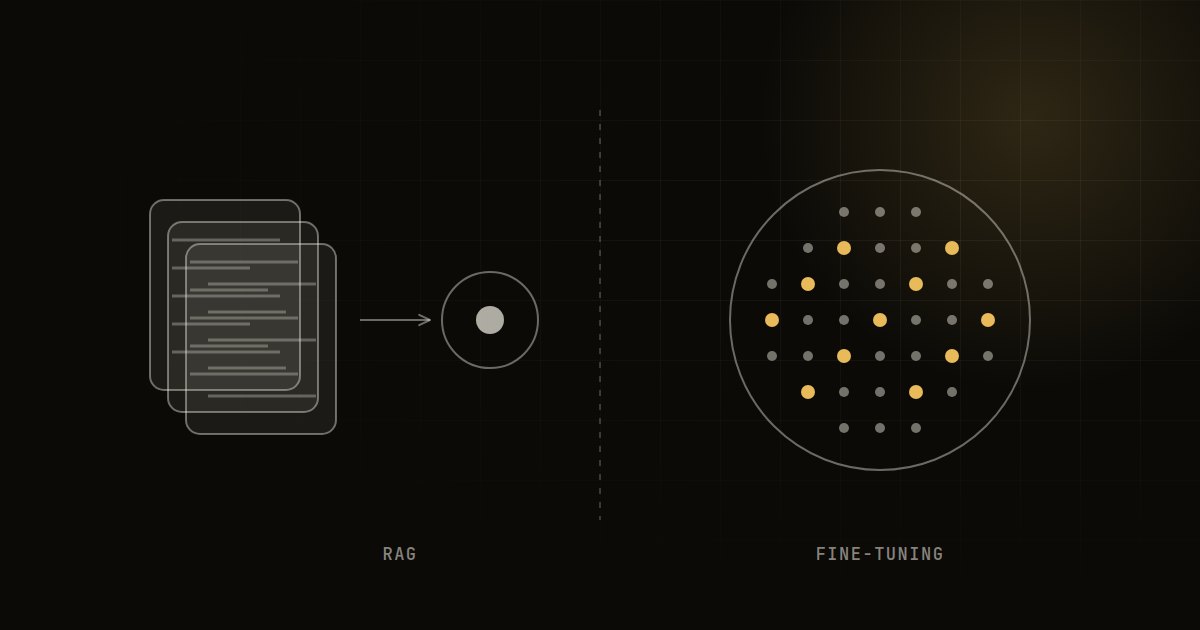
In the RAG vs fine tuning decision, the short answer is this: use retrieval-augmented generation (RAG) when the model needs access to your knowledge, especially knowledge that changes, must be cited or is permission-controlled. Use fine-tuning when you need to change the model's behaviour, such as output format, tone or a narrow task. Many production systems use both.
The confusion usually comes from treating them as two ways of doing the same thing. They are not. RAG changes what the model can see at the moment it answers. Fine-tuning changes the model itself. Once you frame it that way, most decisions become straightforward.
How RAG works
RAG adds a retrieval step before generation. When a user asks a question, the system searches your content (documents, policies, tickets, product data) for relevant passages and inserts them into the prompt. The model then answers using that context.
A typical RAG pipeline has five parts:
- Ingestion: extracting text from source documents and splitting it into chunks.
- Indexing: creating embeddings and storing them in a vector database, often alongside a keyword index.
- Retrieval: finding the most relevant chunks for each query, with filters for permissions and metadata.
- Generation: prompting the model with the query and retrieved context.
- Citation and logging: showing sources to users and recording what was retrieved for evaluation.
Because knowledge lives outside the model, updating it is as simple as re-indexing a document. You can also enforce access control at retrieval time, so users only see answers drawn from content they are allowed to read.
How fine-tuning works
Fine-tuning continues training a pre-trained model on your own examples, typically pairs of inputs and ideal outputs. The model's weights shift so that it reproduces the patterns in those examples more reliably.
Fine-tuning is good at teaching behaviour: always return valid JSON in a given schema, classify tickets into your taxonomy, write in your house style, or follow a specific reasoning pattern for a narrow task. It is poor at teaching facts reliably. A fine-tuned model may absorb some knowledge, but it cannot cite sources, cannot be updated without retraining and may still confidently invent details.
Parameter-efficient methods such as LoRA have made fine-tuning cheaper and faster, but you still need good training data, an evaluation set and a process for retraining when requirements change.
RAG vs fine tuning: side-by-side comparison
| Factor | RAG | Fine-tuning |
|---|---|---|
| What it changes | What the model can see at query time | How the model behaves |
| Best for | Knowledge, facts, documents, frequently changing content | Format, style, tone, narrow repeatable tasks |
| Keeping content current | Re-index documents, often in minutes | Retrain the model |
| Citations and traceability | Natural: you know which sources were used | Difficult: knowledge is baked into weights |
| Access control | Can filter by user permissions at retrieval | Not practical per user |
| Data needed to start | Your existing documents | Hundreds to thousands of high-quality labelled examples, as a rough guide |
| Upfront effort | Moderate: pipelines, chunking, retrieval tuning | Moderate to high: data preparation, training, evaluation |
| Per-request cost | Higher prompts due to retrieved context | Can be lower if a smaller tuned model replaces a larger one |
| Latency | Adds a retrieval step | No retrieval step; smaller models can be faster |
| Main failure mode | Retrieves the wrong or incomplete context | Learns the wrong patterns or overfits |
| Maintenance | Content pipelines, index freshness, retrieval quality | Retraining, versioning, regression testing |
A decision guide
Work through these questions in order. The first "yes" usually points you in the right direction.
- Does the answer depend on information in your documents or systems? Start with RAG.
- Does that information change weekly or monthly? RAG, since retraining on every change is impractical.
- Do users need to see sources, or do auditors need traceability? RAG.
- Do different users have different access rights to the content? RAG with permission-aware retrieval.
- Is the main problem inconsistent output format or style, even with good prompts? Consider fine-tuning.
- Is it a narrow, high-volume task where a smaller, cheaper model could match a large one? Fine-tuning is worth testing.
- Have you exhausted prompt engineering and few-shot examples? If not, try those first. They are cheaper than either option.
In our experience, the right starting point for most enterprise knowledge use cases is a strong base model, careful prompting and well-engineered RAG. Fine-tuning comes later, for specific problems that RAG and prompting cannot fix.
When to combine RAG and fine-tuning
The two approaches are complementary. A combined design uses RAG for knowledge and a fine-tuned model for behaviour.
Consider a typical scenario in financial services: a lender wants an assistant that drafts responses to customer complaints. The responses must reflect current policy and the customer's case history, which suggests RAG. They must also follow a strict regulatory structure and tone every time, which prompting alone handles inconsistently at high volume. A fine-tuned model that reliably follows the structure, fed with retrieved policy and case context, solves both problems.
Another common pattern is fine-tuning a smaller model to handle a high-volume classification or extraction step cheaply, while a larger model with RAG handles the open-ended questions. This can reduce per-request cost significantly; our guide to AI implementation cost explains how usage costs add up.
Common mistakes
Fine-tuning to add knowledge
Teams fine-tune a model on their policy documents and expect it to answer policy questions accurately. It will sound fluent but often gets details wrong, and it cannot tell you where the answer came from. Use RAG for this.
Blaming the model for retrieval problems
When a RAG system gives poor answers, the cause is usually retrieval: badly chunked documents, missing metadata, poor handling of tables or scanned PDFs, or no hybrid keyword search. Fix retrieval before reaching for fine-tuning.
Skipping evaluation
Neither approach can be judged by a handful of demo questions. Build an evaluation set of real queries with expected answers or grading criteria, and measure retrieval quality and answer quality separately. Re-run it on every change.
Ignoring maintenance
RAG needs content pipelines that keep the index fresh and remove outdated documents. Fine-tuned models need retraining when base models are deprecated or requirements change. Budget for both.
How this fits into agents
If you are building agents that take actions rather than just answer questions, the same logic applies. Agents typically use RAG to look up policies and context, and sometimes a fine-tuned model for reliable tool selection or structured outputs. We cover the wider architecture in our guide to enterprise AI agents in production.
Frequently asked questions
Is RAG better than fine-tuning?
Neither is better in general; they solve different problems. RAG is better for giving a model access to current, citable, permission-controlled knowledge. Fine-tuning is better for changing behaviour such as format, tone or performance on a narrow task.
Can you use RAG and fine-tuning together?
Yes, and many mature systems do. A common design uses RAG to supply relevant knowledge and a fine-tuned model to produce consistently structured, on-brand output from that knowledge.
Is fine-tuning cheaper than RAG?
It depends on volume and design. Fine-tuning has upfront data and training costs, but a smaller fine-tuned model can be cheaper per request than a large model with long retrieved context. RAG is usually cheaper to start and to keep current.
Does fine-tuning reduce hallucinations?
Not reliably for factual questions. Fine-tuning can make outputs more consistent in structure, but grounding answers in retrieved sources, with citations and instructions to decline when context is missing, is the more dependable way to reduce fabricated facts.
How much data do you need to fine-tune an LLM?
As a rough guide, a few hundred high-quality examples can shift behaviour for a narrow task, and more complex tasks need more. Quality and consistency of examples matter far more than raw volume.
How Sunday Labs can help
Sunday Labs designs and builds GenAI systems that hold up in production, choosing between RAG, fine-tuning or both based on evidence from your data rather than fashion. Every engagement is led personally by our founder, with senior engineers who build retrieval pipelines, evaluation sets and model operations hands-on. If you are weighing the options for a specific use case, start a conversation.