Why AI Projects Fail Between Pilot and Production, and How to Fix It
Most AI pilots stall before production for predictable reasons. Here is how to spot them early and design pilots that are built to ship.

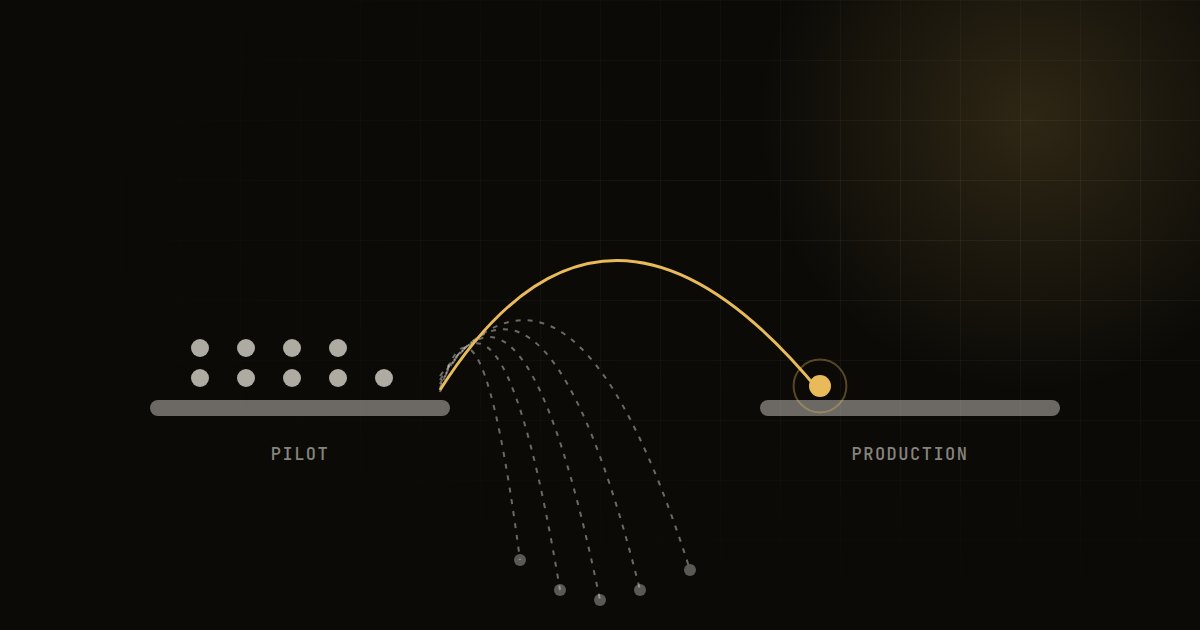
Why AI projects fail usually has little to do with the model. Pilots stall because the business problem and success metric were vague, production data differs from the demo data, nobody owns the outcome, there is no way to evaluate or monitor quality, and integration, security and change management were left until after the demo impressed everyone.
We see the same story repeatedly. A team builds a proof of concept in a few weeks, the demo goes well, leadership is excited, and then six months later the project is quietly parked. The good news is that the causes are predictable, which means they are preventable. This guide covers the common failure modes and how to design a pilot that is built to reach production.
The pilot trap
Pilots are designed to answer "can this work?". Production needs answers to different questions: will it work reliably on messy real data, at our volumes, inside our systems, within our risk appetite, at a cost that makes sense, and will people actually use it?
A pilot optimised for a great demo often makes choices that are fatal later: a hand-cleaned dataset, a single enthusiastic user, a notebook that only one data scientist can run, a generous API budget and no security review. Everything looks green until the move to production exposes all of it at once.
Why AI projects fail: the eight common causes
1. The problem was a solution looking for a use case
"We should do something with GenAI" is not a problem statement. Projects that start from technology rather than a specific, costly business pain struggle to justify production investment. When nobody can say which metric will move and by how much the business cares, the project loses its sponsor at the first budget review.
2. Success was never defined
Many pilots have no agreed threshold for "good enough". Is 85 per cent accuracy acceptable for invoice extraction if the remaining cases go to a human? Is a chatbot successful if it resolves some queries but occasionally gives a wrong answer? Without explicit, business-agreed acceptance criteria, the pilot can never pass, because the goalposts move with each stakeholder.
3. The data in production is not the data in the pilot
Pilots often use a curated extract. Production brings missing fields, new formats, different languages, scanned documents at odd angles and data that arrives late. Data access itself is often the biggest delay: the pilot used a one-off export, but production needs a governed, automated pipeline that security will approve.
4. Nobody owns it
The data science team built it, IT is expected to run it and the business is meant to use it. When each assumes another owns the outcome, issues fall between the gaps. Production AI needs a named business owner accountable for value and a named technical owner accountable for reliability.
5. No evaluation or monitoring
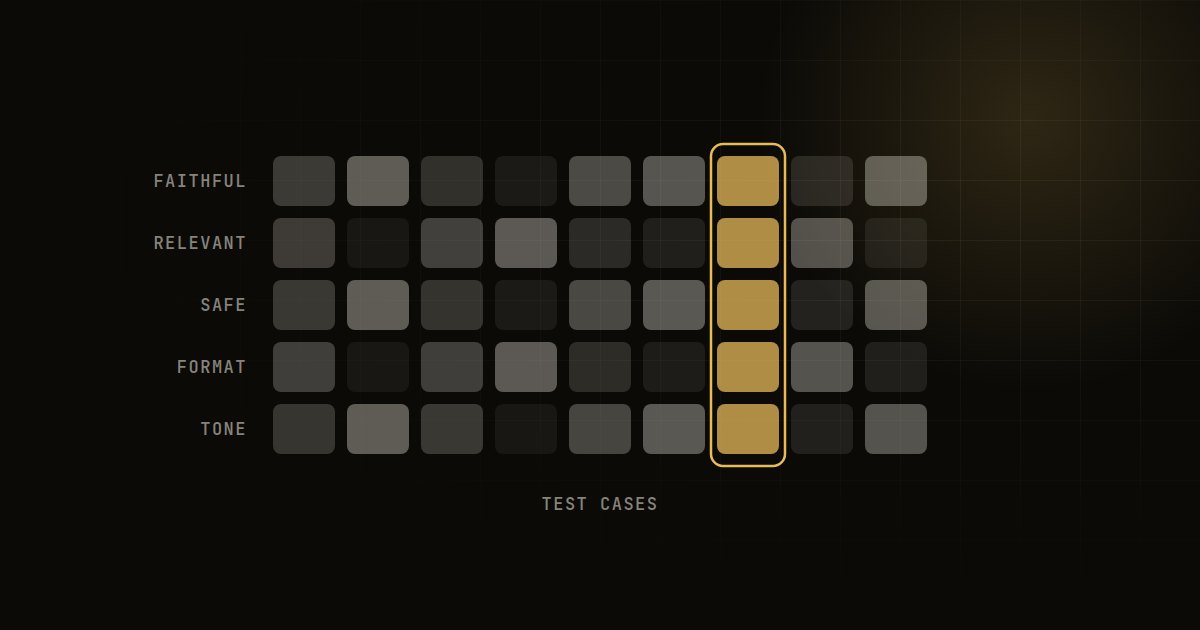
A model that performs well at launch will drift as data, users and the world change. LLM-based systems can regress silently when a prompt, model version or retrieval index changes. Without an evaluation set, automated tests and production monitoring, nobody can prove the system still works, so risk and compliance teams rightly block it. Our guide to LLM evaluation covers how to build this.
6. Integration was an afterthought
Value comes when AI output lands inside the tools people already use: the CRM, the claims system, the ticketing queue. Pilots usually run in a separate interface. Integrating with core systems, handling authentication, logging and failure modes is often more work than the model itself, and it was never in the pilot plan.
7. Risk, security and compliance arrived late
Legal, security and compliance teams often see the system for the first time just before launch. They then raise legitimate questions about personal data, explainability, audit trails and vendor terms. Months of rework follow. In regulated sectors such as financial services or healthcare, this alone can kill a project.
8. People did not change how they work
Even an accurate system fails if users do not trust it, do not understand it or see it as a threat. If the workflow, incentives and training do not change, users route around the tool and adoption flatlines.
Pilot versus production: what changes
| Dimension | Typical pilot | What production needs |
|---|---|---|
| Data | Curated extract, one-off access | Automated, governed pipelines with quality checks |
| Success criteria | "Looks good in the demo" | Agreed metrics and thresholds signed off by the business |
| Evaluation | Spot checks by the builder | Versioned test sets, automated regression tests |
| Infrastructure | Notebook or prototype app | Deployed service with scaling, logging and rollback |
| Integration | Standalone interface | Embedded in existing workflows and systems |
| Ownership | Data science team | Named business and technical owners |
| Risk review | None or informal | Security, privacy and compliance sign-off |
| Cost | Ignored or subsidised | Unit economics modelled and monitored |
| Users | A few champions | Trained users, feedback loops and support |
How to design a pilot that reaches production
The fix is not to skip pilots. It is to design them as the first phase of a production system rather than a standalone experiment.
- Start with a costly, specific problem. Name the process, the metric and its current baseline, for example average handling time per claim or hours spent on monthly reconciliation.
- Agree success criteria upfront. Write down the thresholds that would justify production investment, and get the business owner to sign them.
- Use real data from day one. Work with a representative sample of production data, including the messy cases, under proper access controls.
- Build the evaluation set early. Create a labelled test set with the business, covering common and edge cases, before tuning anything.
- Design for the workflow. Sketch where the output appears, who acts on it and what happens when the AI is unsure. Human-in-the-loop routing is often what makes a system viable.
- Bring risk and security in at the start. A one-hour review in week one saves months later.
- Estimate unit economics. Model cost per transaction at production volumes, including API, compute and human review costs.
- Plan the path to production before the demo. Agree the infrastructure, MLOps or LLMOps tooling, monitoring and owners as part of the pilot scope.
- Set a decision date. At the end of the pilot, decide to scale, change course or stop, based on the agreed criteria. Stopping a weak idea early is a success, not a failure.
A pre-pilot readiness checklist
Before you start, you should be able to answer yes to most of these:
- Is there a named business owner who wants this badly enough to change their team's workflow?
- Can we measure today's baseline for the target metric?
- Do we have access to representative data, and has security agreed how we will use it?
- Do we know which system the output will live in?
- Is there budget and a team to run it after the pilot, not just to build it?
- Have we identified the regulatory or privacy constraints that apply?
If several answers are no, run an AI readiness assessment before starting the pilot. It is cheaper than discovering the gaps six months in.
A typical scenario
Consider a mid-size lender piloting a GenAI assistant to summarise loan files for credit officers. The pilot, built on a handful of clean files, impresses everyone. In production, files contain scanned bank statements, regional language documents and missing pages. Summaries occasionally miss key risk signals, credit officers stop trusting them and compliance asks how errors will be caught.
A production-ready version looks different: document classification and OCR quality checks up front, an evaluation set of real files reviewed by senior credit officers, confidence scoring that flags uncertain summaries for full manual review, audit logs for every output and a dashboard tracking accuracy and usage weekly. The model is almost the same. Everything around it is what makes it shippable.
Frequently asked questions
Why do most AI projects fail?
Most AI projects fail for organisational and engineering reasons rather than model quality. Common causes include vague business goals, no agreed success criteria, data that differs between pilot and production, unclear ownership, weak evaluation and monitoring, late risk reviews and poor adoption by users.
How do you move an AI pilot into production?
Define success criteria before the pilot, use real production data, build an evaluation set, design around the actual workflow and involve security and compliance early. Plan the deployment, monitoring and ownership as part of the pilot so there is a clear path once results are proven.
How long should an AI pilot take?
As a rough guide, a well-scoped pilot takes six to twelve weeks. Longer than that often signals unclear scope or data access problems. The pilot should end with a clear decision to scale, adjust or stop.
What is the difference between MLOps and LLMOps?
MLOps covers the practices and tooling for deploying, monitoring and retraining traditional machine learning models. LLMOps applies similar ideas to systems built on large language models, adding prompt and version management, retrieval pipelines, output evaluation and guardrails. Both exist to keep AI reliable after launch.
Should we stop an AI pilot that is not working?
Yes, if it fails to meet the success criteria agreed at the start and there is no clear, affordable fix. Stopping early frees budget and attention for better opportunities. Record what you learned, especially about data and process gaps, because it will help the next project.
How Sunday Labs can help
Sunday Labs helps companies take AI from pilot to production, covering use case selection, evaluation, MLOps and GenAI engineering, integration and ongoing monitoring. Every engagement is led by our founder, a former CTO, and delivered by senior engineers who have shipped production systems at scale, so pilots are designed to ship from the first week. If you have a pilot that has stalled or one about to start, start a conversation with us.