AI Implementation Cost in India: Drivers, Ranges and Budgeting
A practical guide to AI implementation cost: the real cost drivers, indicative ranges by project type, the running costs people forget and how to budget sensibly.

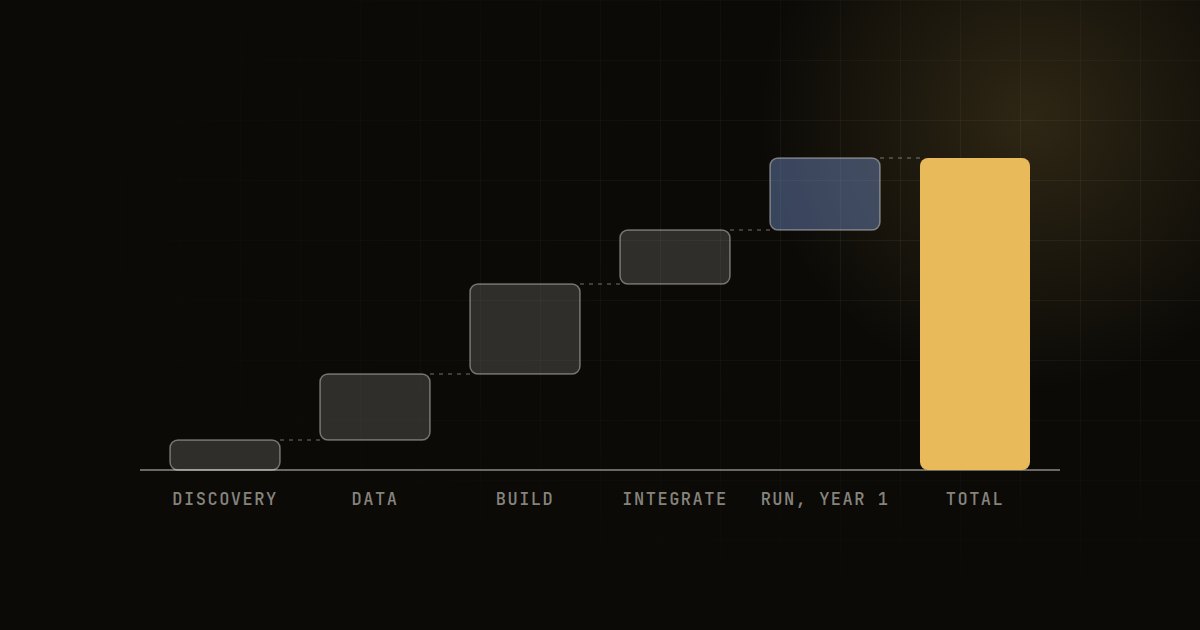
AI implementation cost depends mainly on scope, data readiness, integration effort and ongoing running costs. As a rough guide for Indian organisations, a focused proof of concept may cost in the low tens of lakhs, while a production system with integrations, security and monitoring often runs into crores. Ranges vary widely, so budget by drivers, not headline numbers.
This guide explains where the money actually goes, gives broad indicative ranges by project type, highlights the costs that surprise people after launch and suggests practical ways to spend less without cutting corners.
What drives AI implementation cost
Two projects that sound identical ("an AI assistant for our support team") can differ in cost by an order of magnitude. The difference is almost always in these drivers.
Scope and ambition
A read-only assistant that answers questions from a policy library is far simpler than an agent that updates customer records and triggers refunds. Every action the system can take adds design, testing, guardrails and approval work.
Data readiness
In our experience, data work is often the largest single line item. If the data is clean, accessible through APIs and permissioned, costs stay contained. If it is scattered across spreadsheets, scanned PDFs and legacy systems, expect significant engineering effort before any model sees it.
Integration
AI outputs are only useful when they reach the systems people work in: the CRM, the loan origination system, the ERP, the ticketing tool. Legacy systems without APIs, or vendors who charge for integration access, add both time and cost.
Model approach
Using a hosted foundation model through an API is usually cheapest to build. Fine-tuning, training custom models or self-hosting open models on your own GPUs adds engineering, infrastructure and maintenance. Our comparison of RAG vs fine-tuning covers when each is worth it.
Security, compliance and risk
Regulated sectors need security reviews, audit logging, access control, data residency decisions and sometimes model risk documentation. These are necessary, but they take time and should be in the budget from day one.
Team seniority and location
Senior engineers cost more per day but often cost less per outcome, because they avoid expensive dead ends. Blended teams with a senior lead and mid-level engineers are common.
Indicative cost ranges by project type
The table below is a rough guide only, based on typical engagements for mid-size organisations in India. Actual costs vary widely by scope, data condition, integrations, compliance needs and team model. Treat these as starting points for a conversation, not quotes.
| Project type | Typical scope | Indicative build cost (rough guide) |
|---|---|---|
| Readiness assessment or AI strategy | Use-case prioritisation, data and platform review, roadmap | Roughly ₹5 lakh to ₹25 lakh |
| Proof of concept | One use case, real data, small user group, no deep integration | Roughly ₹10 lakh to ₹40 lakh |
| Production GenAI application | RAG assistant or document processing with integrations, security and monitoring | Roughly ₹40 lakh to ₹1.5 crore |
| Production ML system | Forecasting or scoring model with pipelines and MLOps | Roughly ₹50 lakh to ₹2 crore |
| Multi-use-case platform or agents | Shared data and AI platform, several applications, governance | Often ₹1.5 crore and above |
These figures cover build effort. They exclude licences for third-party software, hardware purchases and the running costs described next. Projects in the US, UK or Middle East, or teams based there, will usually price differently.
Running costs people forget
The build is often not the largest cost over three years. Plan for these recurring items from the start.
- Model usage or inference. Hosted models charge per token. Self-hosted models need GPU capacity whether or not it is busy.
- Cloud infrastructure. Vector databases, storage, compute for pipelines, logging and backups.
- Monitoring and evaluation. Tooling and people time to check output quality, drift and errors.
- Maintenance. Model providers deprecate versions, source systems change and prompts need tuning. Something always needs updating.
- Support and operations. Someone must respond when the system misbehaves, ideally with defined service levels.
- Retraining and data refresh. ML models degrade as the world changes; GenAI knowledge bases need content updates.
As a planning rule of thumb in our experience, set aside an annual running budget of roughly 15 to 30 per cent of the initial build cost, excluding heavy model usage, which should be estimated separately. This varies a great deal, so validate it against your own usage estimates.
How to estimate GenAI usage costs
Model usage cost is easy to underestimate and easy to calculate once you know the inputs. Use this simple formula:
Monthly cost = requests per month × tokens per request × price per token
Consider a typical scenario: an internal assistant handles 2,000 queries a working day. Each query sends a question plus retrieved context, and receives an answer, totalling around 6,000 tokens. That is 12 million tokens a day, or roughly 250 million tokens over about 21 working days. Multiply by your provider's current blended price per million tokens to get a monthly figure.
Three levers change the answer significantly:
- Context size. Retrieving ten long chunks instead of four short ones can multiply cost. Better retrieval often cuts cost and improves quality.
- Model choice. Routing simple queries to a smaller, cheaper model and reserving the most capable model for hard cases.
- Caching. Reusing answers or prompt prefixes for repeated questions.
Check current prices with your provider, since they change frequently.
Build, buy or partner
Cost also depends on who does the work.
| Option | Upfront cost | Running cost | Speed | Best when |
|---|---|---|---|---|
| Buy a SaaS AI product | Low | Per-seat or usage fees, can grow | Fast | The problem is common and the product fits well |
| Build in-house | High (hiring, ramp-up) | Salaries plus infrastructure | Slow to start | AI is core to your product and you need long-term capability |
| Partner with a consultancy | Moderate | Infrastructure plus optional support | Fast | You need specific use cases live soon and want to learn along the way |
| Hybrid | Moderate | Mixed | Fast start, sustainable later | A partner builds the first systems while you hire and take over |
Many organisations start with a partner or SaaS product, prove value, then build internal capability for the use cases that matter most.
Practical ways to reduce AI implementation cost
- Start with a readiness check. An AI readiness assessment catches data and integration blockers before you pay engineers to discover them.
- Pick one use case with a clear baseline. Spreading budget across five pilots usually produces five demos and no production system.
- Use hosted models first. Only move to fine-tuning or self-hosting when volume, latency or data constraints justify it.
- Invest in evaluation early. A small, well-built evaluation set prevents expensive rework later.
- Design for cost from the start. Right-size context, cache where possible and route queries by difficulty.
- Agree phase gates. Fund discovery, then a pilot, then production, with a decision point between each.
- Plan the run. Decide early whether your team or a managed services partner will operate and optimise the system.
Frequently asked questions
How much does AI implementation cost in India?
It ranges from a few lakh for a short assessment to crores for multi-use-case production platforms. The biggest drivers are scope, data readiness, integration and compliance needs. Ask any vendor to break the estimate into these drivers and to include running costs.
Why is AI implementation so expensive?
Usually it is not the model that is expensive but the work around it: preparing data, integrating with existing systems, securing it and keeping it running. Projects that underestimate these areas tend to overrun.
What are the ongoing costs of an AI system?
Model usage or inference, cloud infrastructure, monitoring, maintenance, support and data refresh. As a rough planning figure, many organisations budget a meaningful fraction of the build cost every year, plus usage costs that scale with adoption.
Is it cheaper to build AI in-house or outsource it?
For the first one or two use cases, a partner is often faster and cheaper overall because you avoid hiring and ramp-up time. For AI that is core to your product over many years, in-house capability usually makes more sense. A hybrid approach is common.
How can we reduce GenAI API costs?
Send less context by improving retrieval, route simple queries to smaller models, cache repeated requests and set usage limits per user or team. Monitor cost per request from day one so surprises show up early.
How Sunday Labs can help
Sunday Labs helps organisations scope AI work honestly, including what it will cost to build and to run. Every engagement is led personally by our founder, and senior engineers produce estimates grounded in your actual data, systems and usage rather than generic price lists. If you are building a business case or reviewing a proposal and want a second opinion, start a conversation.